Sfincione Palermo
Sfincione and panelle are the two street foods Palermo is most attached to: a thick, spongy onion-and-anchovy pizza from the bakeries, and chickpea fritters in a sesame roll from the market fryers. This page explains what each one is, where the markets sell them, and how to build a food day around both.
Short answer
Sfincione is Palermo's thick sponge-dough pizza topped with onion, tomato, anchovy and caciocavallo, sold by the slice in bakeries and from street carts. Panelle are chickpea fritters, served hot in a mafalda roll with lemon and salt. Both are at their best in the historic markets, Ballarò, Capo and Vucciria, in the morning and at lunch.
Palermo, the coastal capital of Sicily on the Tyrrhenian Sea, runs on street food the way other cities run on restaurants, and two dishes sit at the centre of that habit: sfincione, a thick sponge-dough pizza topped with onion, tomato, anchovy and cheese, and panelle, chickpea fritters tucked into a sesame-seeded roll. Both cost little, both are eaten standing up or on the move, and both are tied to specific streets and markets rather than to dining rooms.
The wider food scene is covered in the site's Palermo street food overview, and the markets themselves have their own guide to Palermo's markets. This page stays on the two dishes that define the city's fried-and-baked snacking tradition, with the practical details needed to go and eat them.
What Is Sfincione In Palermo?
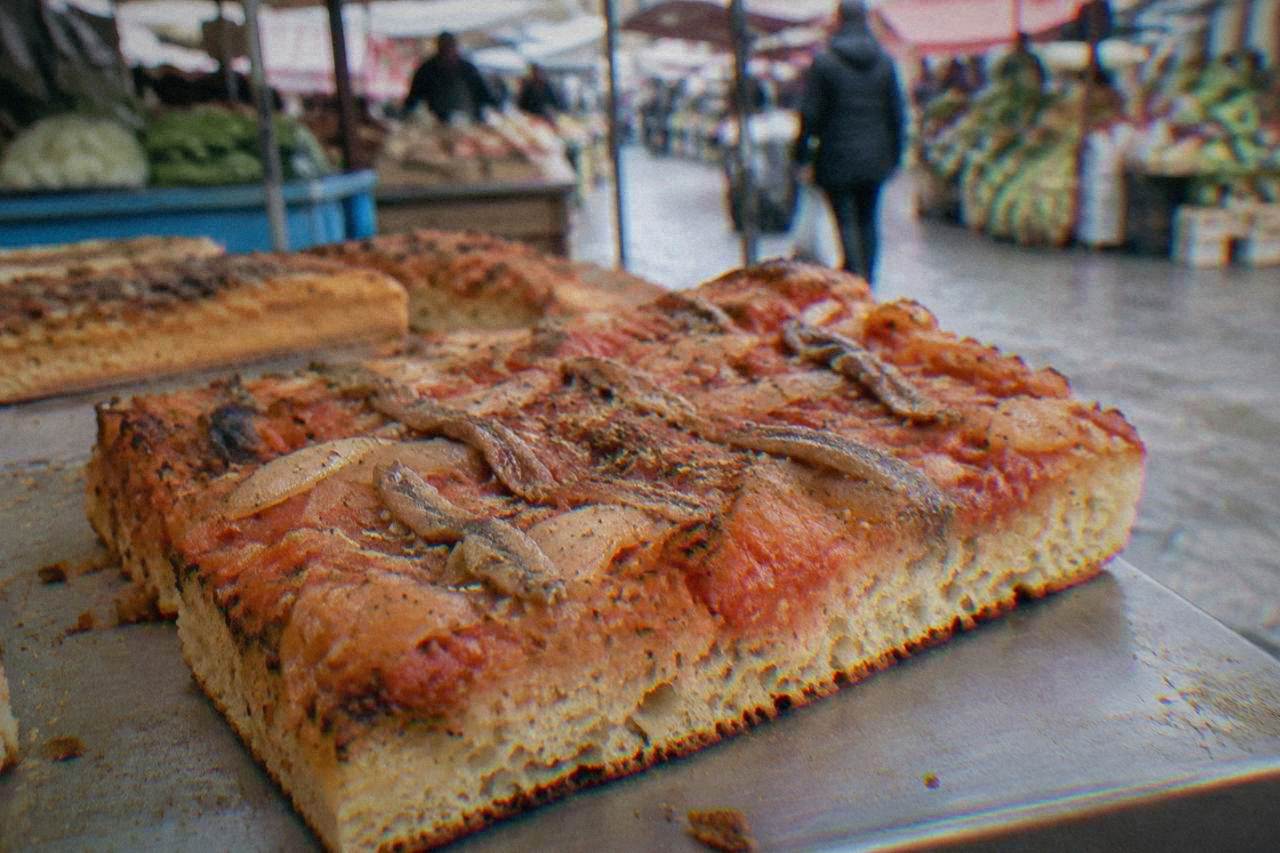
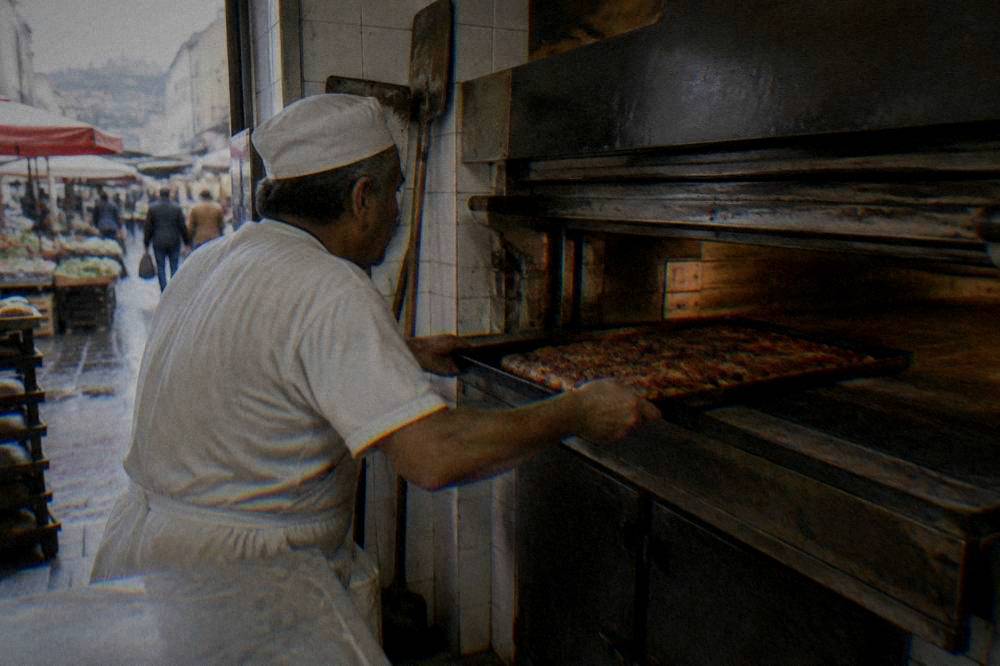
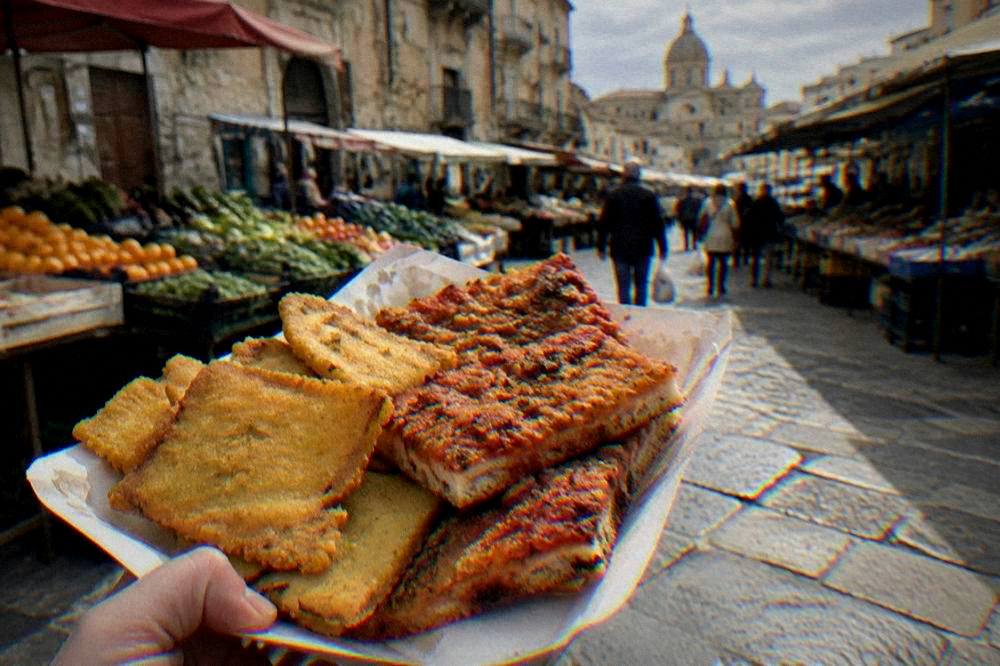
Sfincione is Palermo's own version of pizza: a thick, spongy bread base baked with a sauce of onion, tomato, anchovy and caciocavallo cheese, cut into rectangles and sold by weight or by the slice. The name comes from the Sicilian word for sponge, sfincia, and the texture is the point, soft and oily rather than thin and crisp. Bakeries bring it out in the late morning and again in the evening, and street carts sell it warm from glass cases.
It is not a restaurant dish. The bakeries of the Albergheria and the streets around the Capo market are the traditional territory, and the sfincione they sell is closer to a focaccia with topping than to a Neapolitan pizza. The onion is cooked down slowly until it collapses into the tomato sauce, the anchovy melts through it, and a dusting of grated caciocavallo goes on top before the whole tray goes into the oven.
There is a second style, sfincione palermitano's richer cousin from the province, but in the city itself the bakery version is the one to look for. Eat it within minutes of buying it: the base steams, the onion topping sits on top rather than soaking through, and after half an hour in paper the sponge begins to lose the texture that gives the dish its name.
What Are Panelle And How Are They Served?
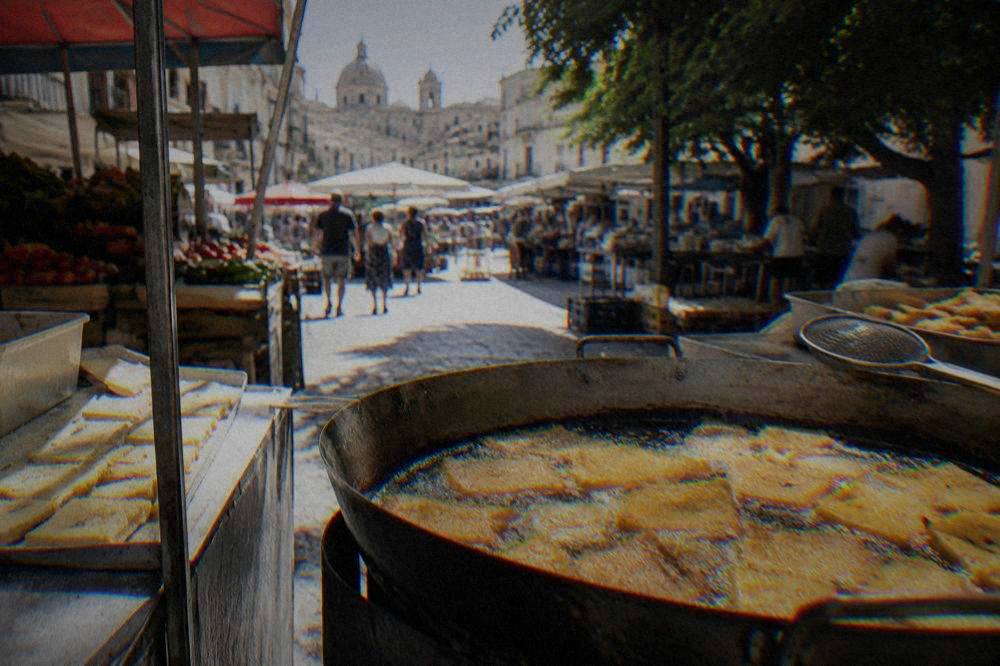
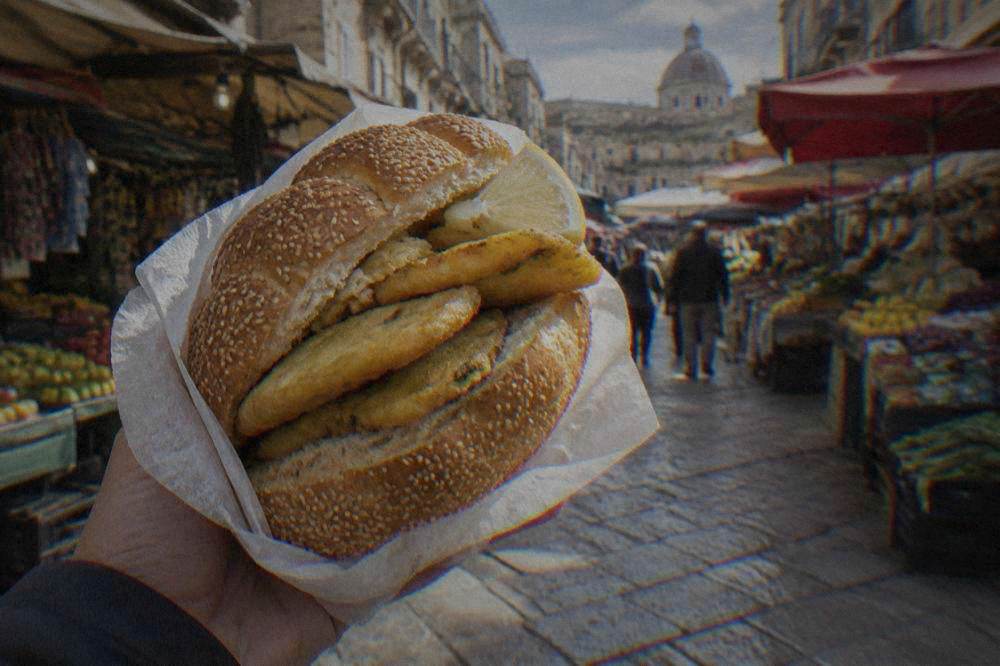
Panelle are fritters made from chickpea flour and water, cooked into a paste, spread thin, left to set, then cut into rectangles and deep-fried to order. In Palermo they are served in a mafalda, a soft sesame-seeded roll, with a squeeze of lemon and salt, and two or three in a roll make a full lunch. The dish is old, cheap and entirely local, tied to the market fryers rather than to any restaurant menu.
The chickpea paste is the whole recipe: no egg, no leavening, just flour, water and parsley cooked on a slab, cooled in sheets and fried fast so the outside crisps while the inside stays soft. The roll matters as much as the fritter. The mafalda's crumb absorbs the oil from the hot panelle, and the sesame gives it a crust that holds together while the fritters steam inside.
Order pane e panelle, and expect it wrapped in paper, handed over immediately and eaten within sight of the stall. A squeeze of lemon is the standard finish. Panelle also turn up on plates as an antipasto in restaurants, but the market version, fried the moment it is ordered, is the form the city is attached to.
A guided walk through the stalls puts the fryers and bakers in context with the city's history, and the site's Palermo food tour guide compares the options.
Between the fried stalls and the bakery counters, the differences come down to texture and time of day.
| Dish | Base | Topping or filling | Where it is sold | When to buy it |
|---|---|---|---|---|
| Sfincione | Thick sponge bread dough | Onion, tomato, anchovy, caciocavallo | Bakeries, street carts with glass cases | Late morning and evening |
| Panelle | Chickpea flour fritter | Mafalda roll, lemon, salt | Market fryers, friggitorie | Morning to early afternoon |
| Arancina | Fried rice ball | Ragù or butter and ham, in Palermo usually round | Fryers and bars, all day | Any time |
| Panelle e crocche | Mixed fritters | Potato croquettes added to the roll | Market fryers | Morning to early afternoon |
The arancina has its own page in the site's guide to Palermo arancine, including the Accademia della Crusca's ruling that both arancina and arancino are acceptable, with Palermo and western Sicily saying arancina.
Where Do You Find The Best Sfincione And Panelle In Palermo?
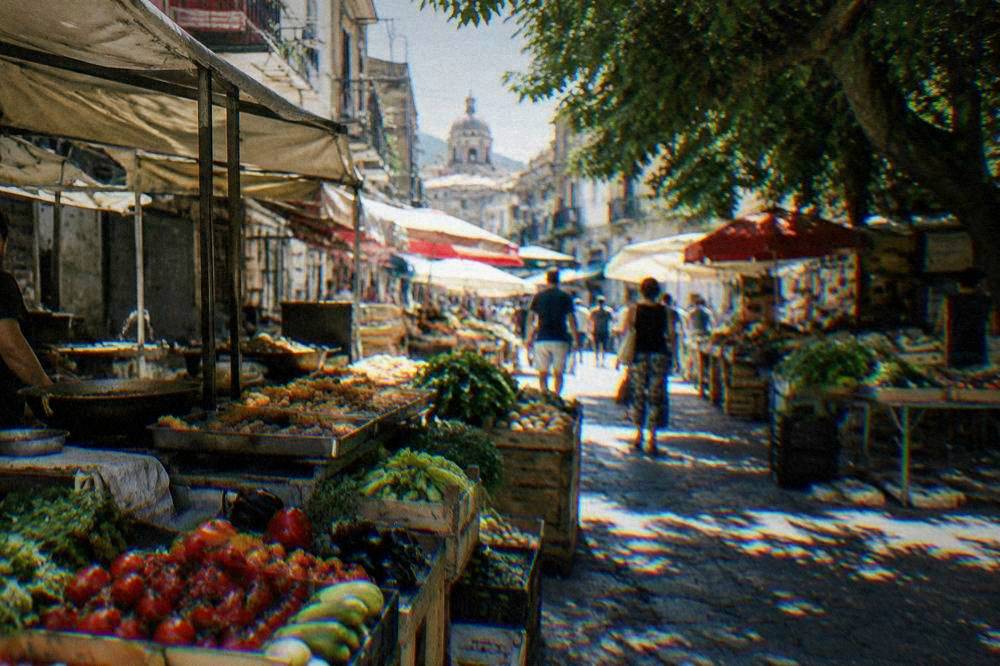
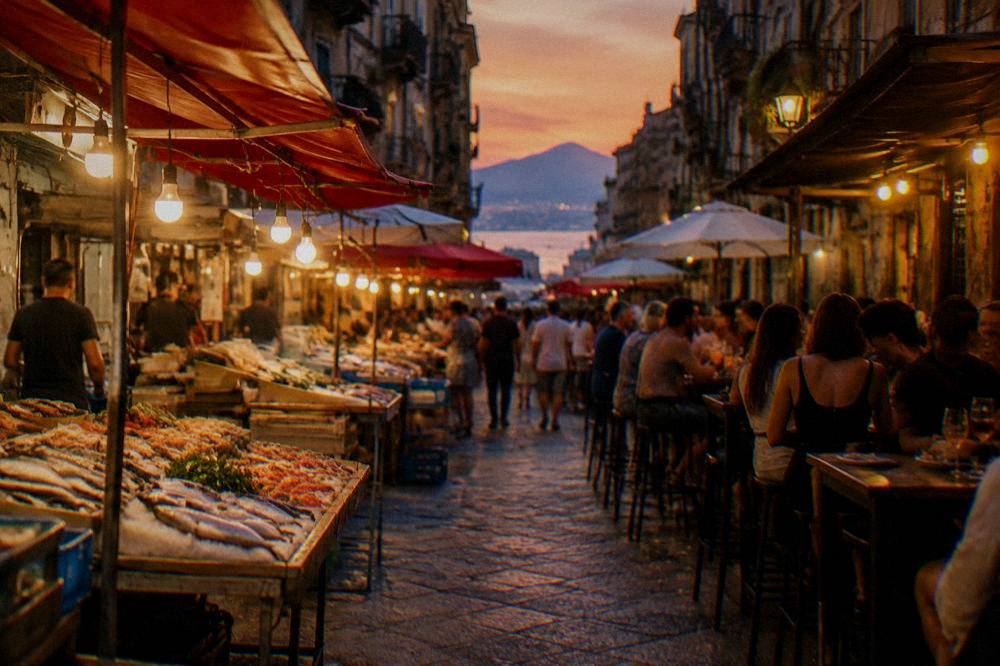
The historic markets are the answer: Ballarò for panelle and the widest spread of fried food, the Capo for bakeries and morning fryers, and Vucciria for the evening street scene. Ballarò runs Monday to Saturday from about 7:30 and on Sunday mornings; the Capo trades in the mornings and rests on Sunday; Vucciria's daytime market gives way to bars at night. All three are free to walk through, and all three sit inside the old centre.
Ballarò is the biggest of them, spreading south of the Cassaro through the Albergheria edge, and it is the one where a friggitorie will fry panelle to order in front of you. The Capo, running north from the Cassaro toward the cathedral streets, is tighter and louder in the morning, with bakery windows doing steady trade in sfincione by late morning. Vucciria, between the Cassaro and the port side, is quieter as a daytime food market and comes alive after dark as a drinking street.
Hours are habits rather than fixed timetables. The municipal tourism page describes Ballarò trading Monday to Saturday from about 7:30, with Sunday mornings as a reduced session, and stallholders pack up when the produce is gone, so a late afternoon visit can find the fryers already closed. Go in the morning for the full spread, and treat the hours below as a planning range rather than a promise.
| Market | Days | Rough hours | Best for | Nearest reference point |
|---|---|---|---|---|
| Ballarò | Monday to Saturday, Sunday mornings | From about 7:30, winding down by late afternoon | Panelle, mixed fried food, produce | South of Corso Vittorio Emanuele, Albergheria edge |
| Capo | Monday to Saturday | Mornings | Sfincione from bakeries, morning fryers | Via Sant'Agostino, north of the Cassaro |
| Vucciria | Monday to Saturday | Daytime market, evening bars | Evening street food and drinks | Piazza Caracciolo, near the port side |
A guided option pairs the stalls with the stories behind them, and a food walk can be booked with free cancellation up to 24 hours before: Check availability.
How Do You Build A Street Food Day Around Sfincione And Panelle?
Start at Ballarò between 8:00 and 10:00, when the fryers are at their busiest and the panelle come out of the oil to order; walk north through the old centre past the Quattro Canti; take sfincione from a bakery near the Capo before the lunch trays sell down; and finish the circuit at the Vucciria in the early evening, when the food stalls close and the bar scene opens. The whole route is on foot inside the four mandamenti.
The old centre is compact. The crossing of Via Maqueda and Corso Vittorio Emanuele at the Quattro Canti divides it into four districts, the Capo, the Albergheria, the Kalsa and the Loggia, and the municipal tourism page names each one after its principal building. Ballarò sits on the Albergheria side, the Capo gives its name to the northern district, and Vucciria falls toward the Loggia and the old harbour of La Cala, so the route above is a single loop with no transport needed.
Pace matters more than distance. Fried food in Palermo arrives fast and hot, portions are generous, and the habit is to eat small amounts in several places rather than one sit-down meal. Tap water is drinkable, AMAP states the city's distributed supply is suitable for consumption, so a refillable bottle covers the day. The guide to getting around Palermo covers the transport options if the loop is extended out to Mondello or Monreale.
| Time | Stop | What to eat | District |
|---|---|---|---|
| 8:30 | Ballarò market | Panelle in a mafalda, lemon and salt | Albergheria edge |
| 10:30 | Cassaro and Quattro Canti | Walk, coffee, no food needed | Border of all four districts |
| 11:30 | Capo market bakeries | Sfincione by the slice | Capo |
| 13:00 | Kalsa streets | Sit-down lunch or more fried food | Kalsa |
| 18:30 | Vucciria | Evening street food, drinks | Loggia |
What Do Sfincione And Panelle Cost, And How Do You Order?
Neither dish carries an official price list, and this site prints no figure that a stall has not published, so treat prices as small: panelle and sfincione are working food, priced in coins rather than notes, and each stall posts its own board. Order at the counter, point at what you want, pay when handed the food, and check the itemised bill if you sit down anywhere afterwards. Coperto, the cover charge, is legal when printed on the menu, and tipping is not obligatory.
Ordering is plain Italian or pointing. Pane e panelle gets the roll; sfincione is sold by the slice or by weight, and the seller will indicate the piece before cutting. A mixed fry, panelle e crocche, adds potato croquettes to the roll. Bread and fried food come wrapped in paper, and the habit is to eat within a few steps of the stall.
The only figures worth memorising for the day are the transport ones. The AMAT fares page lists the tickets:
| AMAT ticket | Price | Validity |
|---|---|---|
| Single, bought in advance | 1.40 EUR | 90 minutes from validation |
| Single, bought on board | 1.80 EUR | 90 minutes from validation |
| Day ticket | 3.50 EUR | Until end of service on the day |
| Two-day MultiDay | 6.00 EUR | Until end of service on the second day |
| Three-day MultiDay | 8.00 EUR | Until end of service on the third day |
Tickets are bought before boarding where possible and validated at once on the vehicle, as the AMAT fares page states. The four tram lines and the bus network share the same tickets.
For anyone who wants the frying taught rather than bought, the site's Palermo cooking class guide covers the kitchen options.
If you would rather cook these dishes yourself, book a Sicilian cooking class here.
When Is The Best Time Of Year For A Street Food Trip To Palermo?
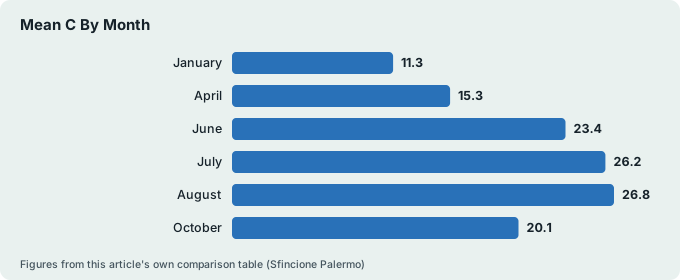
The climate table points to April, May, June, September and October as the comfortable months: means of 15.3, 19.1, 23.4, 23.4 and 20.1 C respectively, against July and August means of 26.2 and 26.8 C. October is the wettest month at 81 mm and July the driest at 7 mm, all figures from the modelled ERA5 1991 to 2020 normals. Fried food tastes the same in August, but standing in a market lane at midday does not.
The July Festino of Saint Rosalia, held each July from the 10th to the 15th with the chariot procession on the 14th and the silver urn procession on the 15th, fills the Cassaro with street food stalls alongside the celebrations, and it is the one moment when sfincione and panelle move from the markets to the festival street. The trade-off is heat and crowds. Winter means of 11.3 C in January and 12.8 C in December are mild, and the fryers work year-round.
| Month | Mean C | Rain mm | Notes for a food trip |
|---|---|---|---|
| January | 11.3 | 69 | Mild, quiet markets |
| April | 15.3 | 59 | Comfortable walking weather |
| June | 23.4 | 15 | Long days, light rain |
| July | 26.2 | 7 | Festino, 10 to 15 July, heat |
| August | 26.8 | 19 | Warmest month, many residents away |
| October | 20.1 | 81 | Wettest month, cooler stalls |
The guide to the best time to visit Palermo works through the whole year in more detail.
Can You Combine A Food Day With Trips Out Of Palermo?
Yes, and the two sit together easily: the markets run in the morning, the day trips run all day, and the driving times from Quattro Canti are short by Sicilian standards, 16 minutes to Monreale, 27 minutes to Mondello, 65 minutes to Cefalu and about 2 hours 20 to Agrigento's Valley of the Temples by free-flowing road. Eat in the city on arrival day, then use the middle days for the trips and return to the markets each evening.
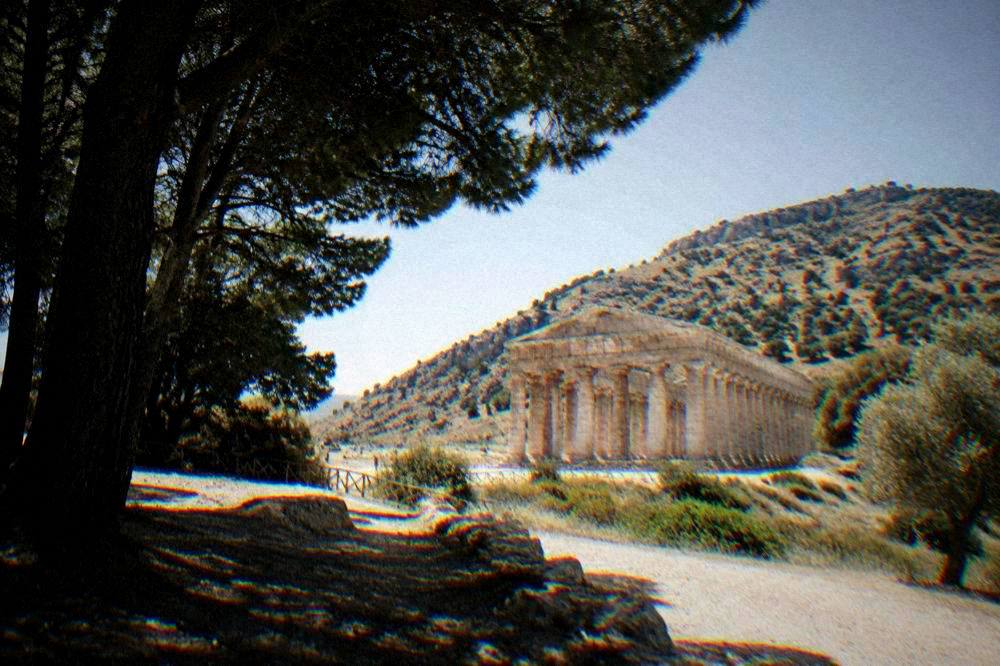
Mondello, the beach district 13.9 km from the Quattro Canti, has its own fryers along the seafront in summer, served by AMAT's seasonal line 806, so panelle travel with you to the beach. Monreale, reached by AMAT line 389 from Piazza Indipendenza on a 1.40 EUR ticket, pairs the cloister visit with a hill-town lunch rather than market food. Further out, Segesta at 64 minutes, Erice at 96 and Scopello at 77 make a full west-coast loop, and that loop is where a booked excursion earns its keep, since the public transport between those three is thin.
| Destination | Road time from Quattro Canti | Distance | Public transport |
|---|---|---|---|
| Monreale | 16 min | 10.4 km | AMAT 389 from Piazza Indipendenza |
| Mondello | 27 min | 13.9 km | AMAT summer line 806 |
| Cefalu | 65 min | 71.5 km | Train, about 40 to 60 minutes |
| Segesta | 64 min | 76.2 km | Regional coach routes |
| Agrigento, Valley of the Temples | 136 min | 129 km | Direct train, about 2 hours |
An organised excursion covers the western loop in one booking, and the Segesta, Erice and salt pans trip pairs a temple site with a hill town and the Trapani salt pans: Check availability. The site's guide to four or five days in Palermo sequences the trips against city days.
What Else Should You Know Before Eating Your Way Around Palermo?
A few practical rules cover the whole day: tap water is drinkable per AMAP; coperto is legal when printed on the menu and tipping is not obligatory; petty crime such as pickpocketing around tourist sites and on public transport is what the US State Department and UK FCDO advisories flag for Italy, so keep bags closed and in front on crowded buses; and the tourist tax applies to non-residents for a maximum of 4 consecutive nights, confirmed at booking. Emergency calls go to 112.
Money is euro cash and cards, and small stalls prefer coins. The markets close early compared with northern European habits, so the eating window is roughly 8:00 to 15:00 for the freshest frying, with Vucciria picking up again after dark. Sunday is the thinnest day: the Capo rests, Ballarò runs a morning-only session, and bakeries operate reduced hours.
For anyone building the rest of the trip, the site's Palermo restaurants guide covers sit-down meals, and the wider Palermo Italy Travel Guide holds the itineraries, day trips and practical pages. Three days is the site's baseline for the city plus one day trip, set out in how many days in Palermo.
Common Questions About Sfincione And Panelle In Palermo
What is sfincione?
Sfincione is Palermo's thick, spongy pizza: a bread-dough base baked with a topping of slow-cooked onion, tomato, anchovy and caciocavallo cheese, cut into rectangles and sold by the slice from bakeries and street carts. The name comes from the Sicilian word for sponge.
What are panelle made of?
Panelle are made from chickpea flour and water, cooked into a paste with parsley, spread thin, left to set, then cut into rectangles and deep-fried. They are served hot in a sesame mafalda roll with lemon and salt.
Where can I eat sfincione and panelle in Palermo?
In the historic markets: Ballarò for panelle fried to order, the Capo for sfincione from the bakeries, and Vucciria for evening street food. All three sit inside the old centre and are free to walk through.
When are Palermo's markets open?
Ballarò runs Monday to Saturday from about 7:30 with a Sunday morning session; the Capo trades mornings and rests on Sunday; Vucciria's daytime market runs Monday to Saturday and the bars take over in the evening. Hours are habits rather than fixed timetables.
Is sfincione the same as pizza?
No. The base is thicker and spongier than pizza dough, the topping is dominated by slow-cooked onion with anchovy rather than cheese-led, and it is sold from bakery counters and street carts by the slice or by weight rather than made to order at a table.
Can I drink tap water in Palermo?
Yes. AMAP states that the water distributed in Palermo is suitable for human consumption, so a refillable bottle covers a day in the markets.
Sfincione and panelle are the two dishes that explain how Palermo eats: fast, fried or baked that morning, sold standing up and priced for the people who live with them every day. Go to the markets early, eat in small amounts across several stalls, and the city's food tradition opens up one paper-wrapped portion at a time.