Quattro Canti Palermo
The Quattro Canti is the four-cornered crossing where Via Maqueda meets Corso Vittorio Emanuele, the point that splits Palermo's old centre into its four historic quarters.
Short answer
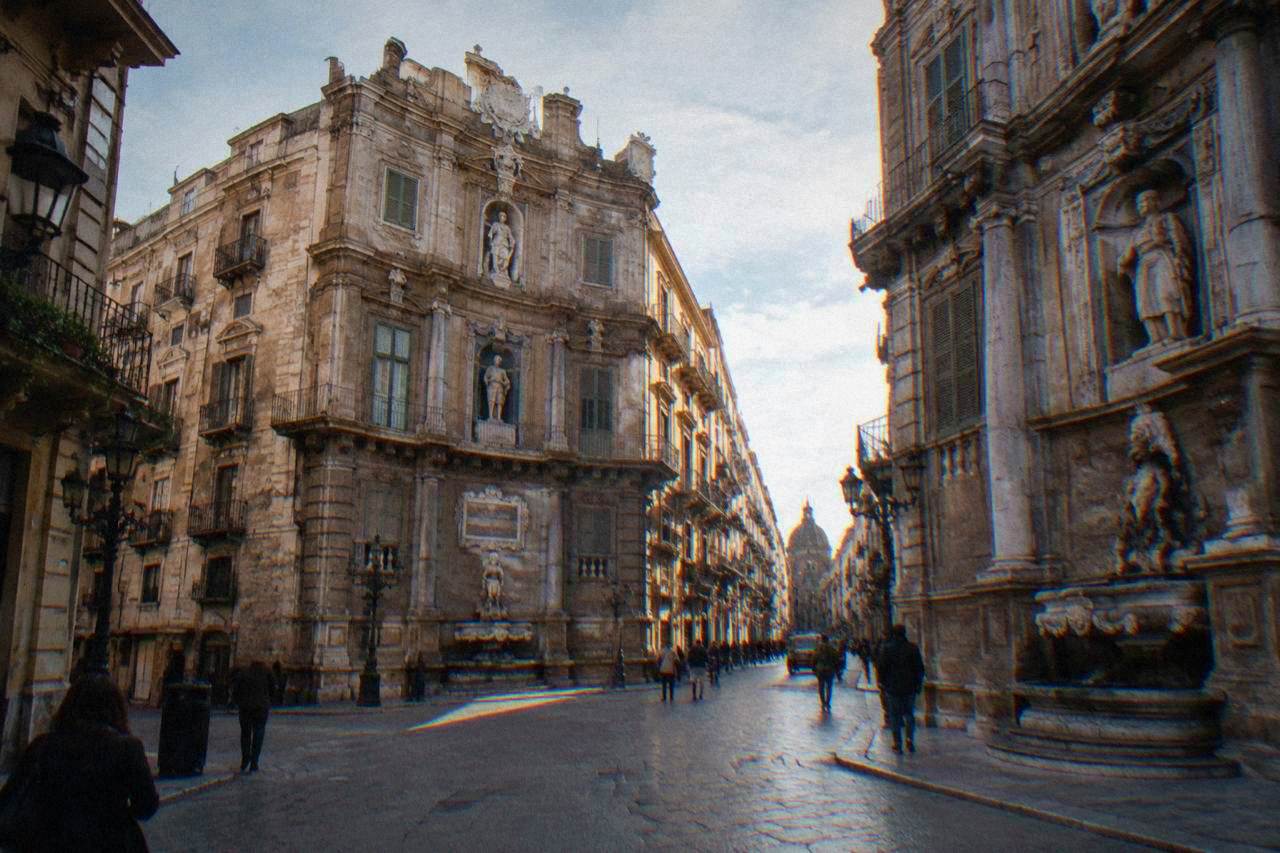
The Quattro Canti is the crossing of Via Maqueda and Corso Vittorio Emanuele in central Palermo, where four curved corner palaces with fountains and statues divide the old centre into the four historic quarters of Capo, Albergheria, Kalsa and Loggia. It is a public square and free to see at any hour.
The Quattro Canti is the four-cornered crossing at the heart of Palermo, the coastal capital of Sicily on the Tyrrhenian Sea, where the city's two great old streets, Via Maqueda and Corso Vittorio Emanuele, meet. Four curved palace facades rise on the four corners, each layered with fountains and statues, and the municipal tourism page describes how this crossing divided the old city into the four parts called mandamenti. Nothing here is ticketed or fenced off. The Quattro Canti is a working street crossing, free at any hour, and it works as the natural orientation point for every walk through the historic centre described on this site's things to do in Palermo page.
What Is The Quattro Canti In Palermo?
The Quattro Canti is the crossing where Via Maqueda and Corso Vittorio Emanuele intersect in central Palermo, formed by four curved corner palaces decorated with fountains and statues. The municipal tourism page states that the crossing split the city into four parts called mandamenti, each named after its most important civic building: Capo or Monte di Pietà, Albergheria or Palazzo Reale, Kalsa or Tribunali, and Loggia or Castellammare.
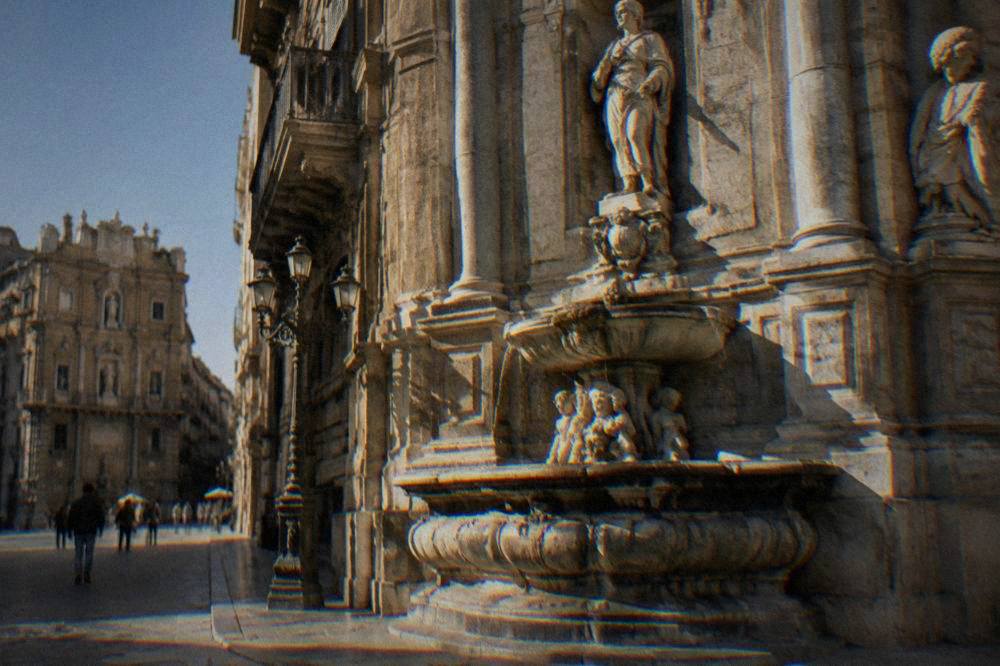
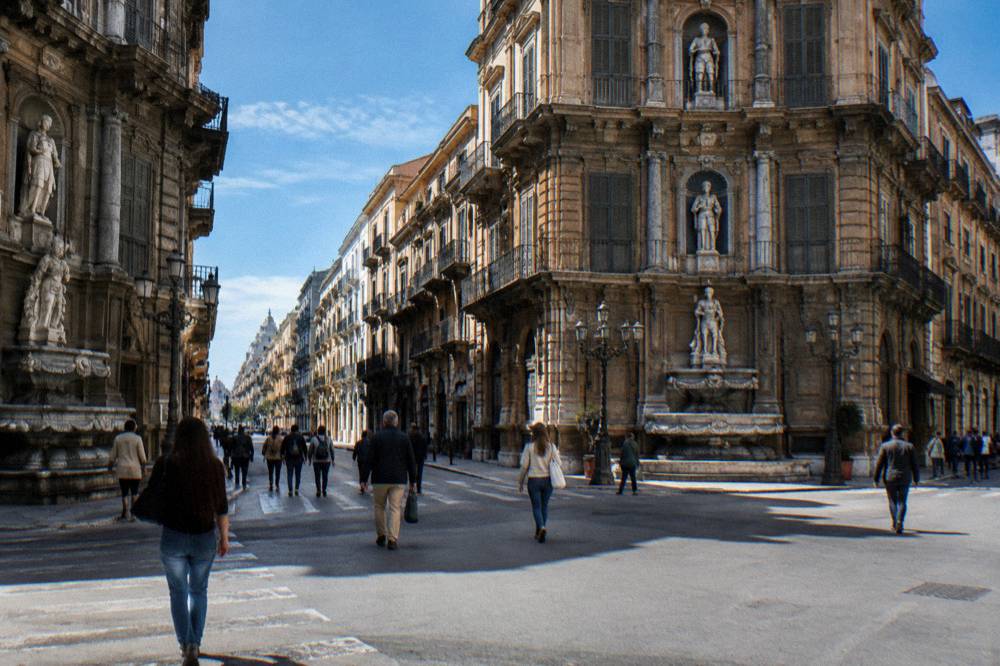
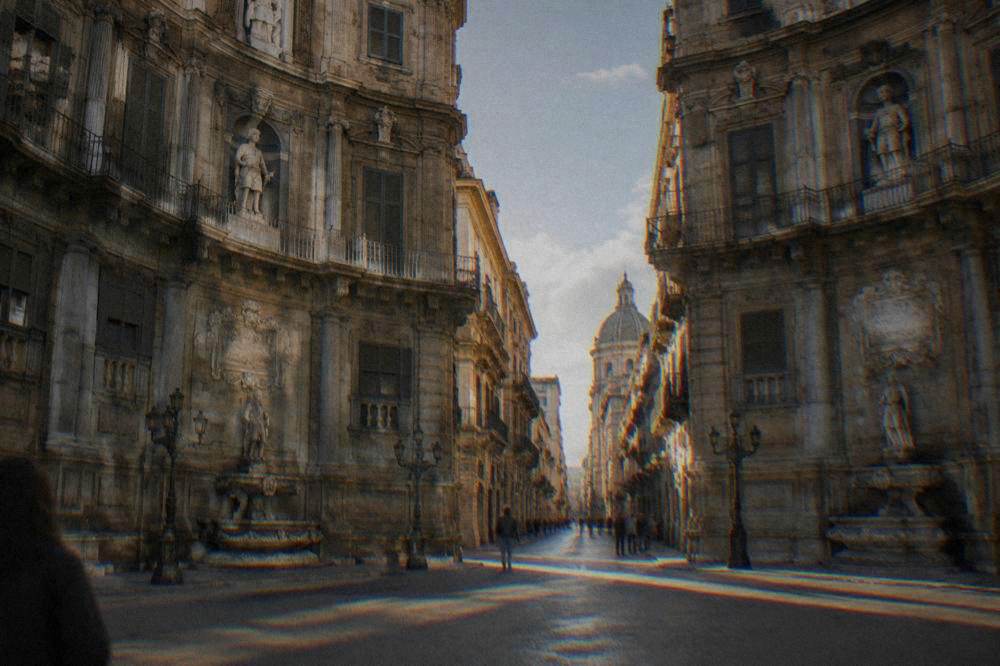
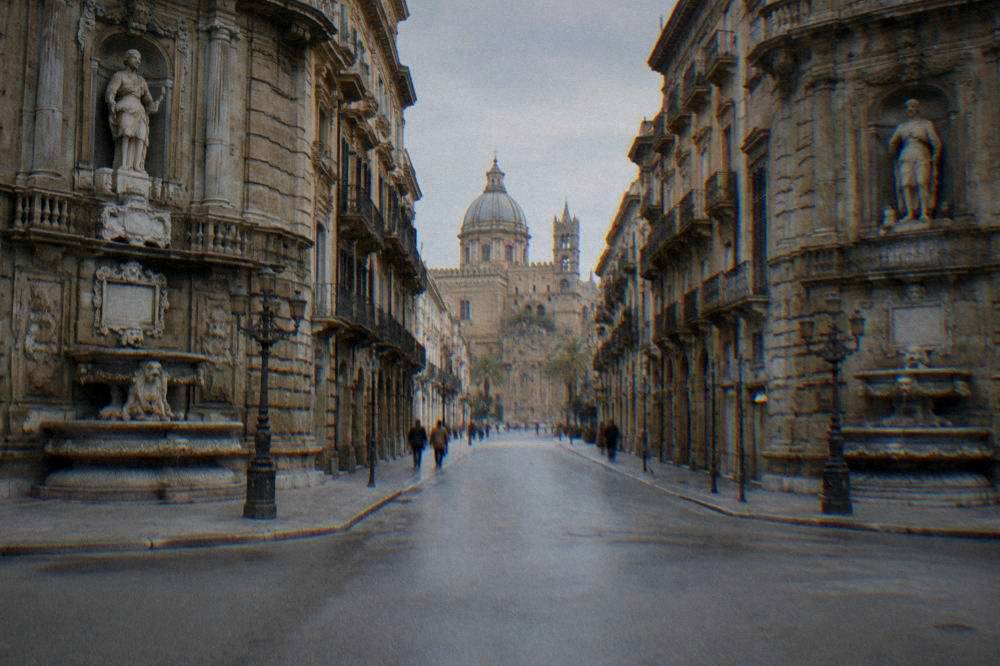
It is a square that is really a crossroads. Traffic passes through, buses run along the streets, and pedestrians gather on the corners, which is exactly why it became the reference point for the whole old centre. The four facades curve inward to face one another across the intersection, so from any corner you can see the other three, and each facade carries its own fountain at street level. Standing in the middle of the crossing at a quiet moment gives the clearest view of all four at once.
The name simply means "four corners" or "four songs", and locals also call the spot Piazza Vigliena after the viceroy linked to the street that created it. The municipal tourism page is the source for the mandamenti names, and it is the detail that turns a photo stop into a genuinely useful orientation tool. Once you know that Capo lies toward the sea along one axis and the Kalsa along the other, the old centre stops being a maze.
Where Exactly Is The Quattro Canti In Palermo?
The Quattro Canti sits at the exact centre of Palermo's historic old town, at the point where Via Maqueda, which runs north toward the Politeama theatre, crosses Corso Vittorio Emanuele, the old east-west street that runs from the cathedral quarter down to the sea at Porta Felice. Every major old-centre sight lies within a short walk of the crossing.
Via Maqueda is the north-south spine of the old centre. Walk north along it and you pass shopfronts and cafes toward the Teatro Politeama and the newer city beyond; the site's Politeama and the new city guide covers that stretch. Walk south along Via Maqueda and you reach the Teatro Massimo after a short walk, the opera house whose guided tours cost 14 EUR full and 7 EUR reduced according to its own tour page.
Corso Vittorio Emanuele, known as the Cassaro, is older still and is the street the whole city grew along. East of the Quattro Canti it runs downhill to the Foro Italico waterfront and the old harbour. West of the crossing it climbs past the Piazza Pretoria fountain, the cathedral quarter and onward toward the Norman Palace. A good mental map is one line for each street, with the Quattro Canti where they cross.
Food is one of the strongest reasons to start at this crossing, because the street food culture of the old quarters sits all around it. A guided tasting walk anchored in the old centre, like the street food walking tour with a local guide, covers the markets and the classic snacks of the four quarters; Check availability if that suits your dates.
How Much Time Do You Need At The Quattro Canti In Palermo?
Plan on fifteen to thirty minutes to appreciate the Quattro Canti itself: enough time to view all four facades, read the fountains and statues, and photograph the crossing from several angles. The crossing rewards a slower pass at golden hour, when the low sun lights the facades, but it remains a free public space you can cross again and again during a stay.
There is no ticket desk, no queue and no gate. The crossing is a junction on two live streets, so the practical constraint is traffic rather than opening hours. Morning light falls across the western corners and late afternoon light across the eastern ones, so photographers who want all four corners well lit often make two short visits in one day rather than one long one.
Because the crossing is the hub of the old centre, the honest advice is not to treat it as a destination but as a base. Fifteen minutes of standing and looking is enough for the square itself; the surrounding blocks hold enough markets, churches and palaces to fill the rest of a day, and the site's one day in Palermo itinerary uses the crossing as its centre of gravity.
If you'd rather have a guide walk you through the old quarters, book a free welcome walking tour here.
What Can You See On Each Of The Four Corners In Palermo?
Each of the four Quattro Canti corners belongs to one of the historic quarters, and the municipal tourism page names them: Capo or Monte di Pietà, Albergheria or Palazzo Reale, Kalsa or Tribunali, and Loggia or Castellammare. Each facade carries a fountain with a statue, and each quarter spreads out from its corner toward its own market, church or palace.
The four corners are best read as a compass. The table below sets out what each corner gives you, using the mandamenti names from the municipal tourism page and the sights covered elsewhere on this site.
| Corner / Quarter | Also Named After | What You Reach From It |
|---|---|---|
| Capo | Monte di Pietà | The Capo market street and the cathedral quarter toward the sea |
| Albergheria | Palazzo Reale | The Norman Palace, the Ballarò market and the cathedral |
| Kalsa | Tribunali | The Kalsa quarter, the Foro Italico waterfront and the old harbour |
| Loggia | Castellammare | The Vucciria market area and the old port district toward La Cala |
The practical payoff is navigation. The Capo corner points you toward the market of the same name, covered in the site's Capo and Palermo markets pages, and the Albergheria corner toward the royal palace whose combined ticket with the Palatine Chapel is 14.50 EUR full and 12.50 EUR reduced per the Palazzo dei Normanni visit page. The Kalsa corner leads to the sea, and the Loggia corner to the old harbour at La Cala.
A glass of Sicilian wine works as a mid-route pause on this circuit, and a guided tasting with snacks at a bottega in the centre covers the island's grapes without a detour. The listing carries the current price and times.
What Sights Are Within Walking Distance Of The Quattro Canti In Palermo?
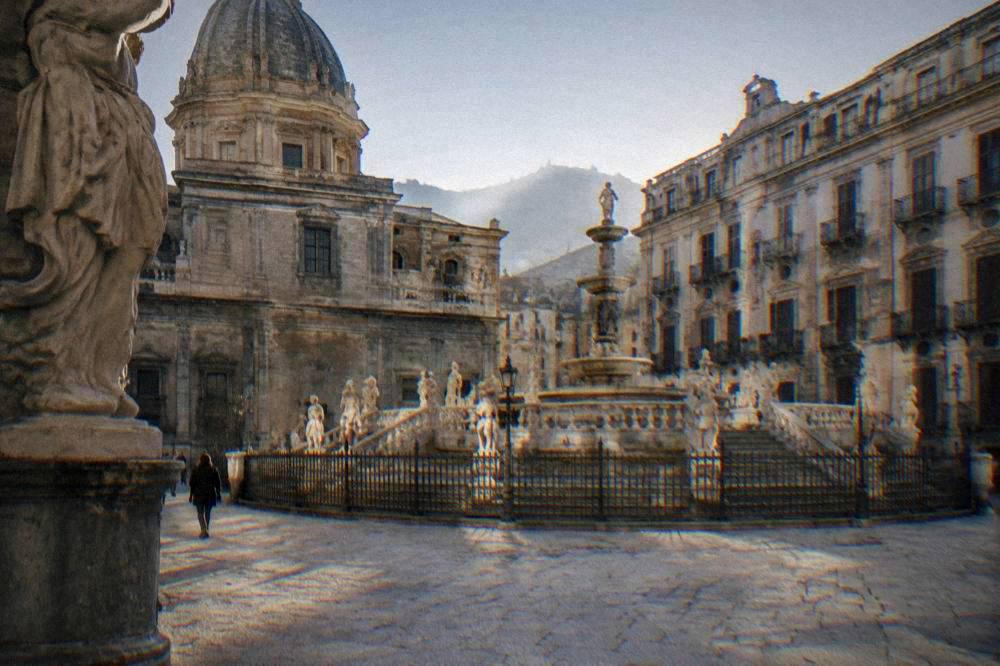
Piazza Pretoria with its famous fountain lies one block west along Corso Vittorio Emanuele, the cathedral and the Norman Palace sit uphill beyond it, the Teatro Massimo stands a short walk north along Via Maqueda, and the Ballarò market sprawls south of the crossing. Every one of these is reachable on foot, and the site's old town guide covers the full circuit.
The density here is the point. The full index of guides sits on Palermo Italy Travel Guide.
| Sight | Direction From The Crossing | Entry |
|---|---|---|
| Piazza Pretoria | One block west on Corso Vittorio Emanuele | Free, exterior viewing |
| Palermo Cathedral | Uphill west, short walk | Nave as a church; monumental area ticketed, price at the ticket point |
| Norman Palace and Palatine Chapel | Further west, short walk | 14.50 EUR full, 12.50 EUR reduced |
| Teatro Massimo | North along Via Maqueda, short walk | Guided tour 14 EUR full, 7 EUR under 26 |
| Ballarò market | South of the crossing | Free |
| San Cataldo and La Martorana | East along Corso Vittorio Emanuele, short walk | Free, exterior viewing |
Church dress is worth remembering on this circuit: the cathedral is a working church, so covered shoulders and knees are the safe choice. The Palermo Cathedral page on this site carries the full history, including the years 831 and 1072 when the earlier church became a mosque and then returned to Christian worship, and the royal tombs of Roger II, Frederick II and others inside.
The crossing also sits inside the UNESCO inscribed property. The Arab-Norman Palermo and the Cathedral Churches of Cefalu and Monreale listing, inscribed in 2015, covers nine components across the city, several of which sit within walking distance of the Quattro Canti, including the Royal Palace and Palatine Chapel, the cathedral, La Martorana, San Cataldo and San Giovanni degli Eremiti.
When Is The Best Time Of Day To Visit The Quattro Canti In Palermo?
Early morning and the hour before sunset are the two best windows for the Quattro Canti: morning brings low sun across the western facades and quiet streets before the market crowds build, while late afternoon light warms the eastern corners and the surrounding streets fill with the passeggiata. Midday in summer is the harshest light and the busiest junction.
The climate table for Palermo, modelled ERA5 normals for 1991 to 2020, shows why timing matters in summer: July averages 26.2 C and August 26.8 C as monthly means, with August's average maximum at 30.4 C. On an August afternoon the crossing offers little shade, so the early morning pass and the evening pass are not just about photography, they are about comfort. October is the wettest month at 81 mm and July the driest at 7 mm on the same table.
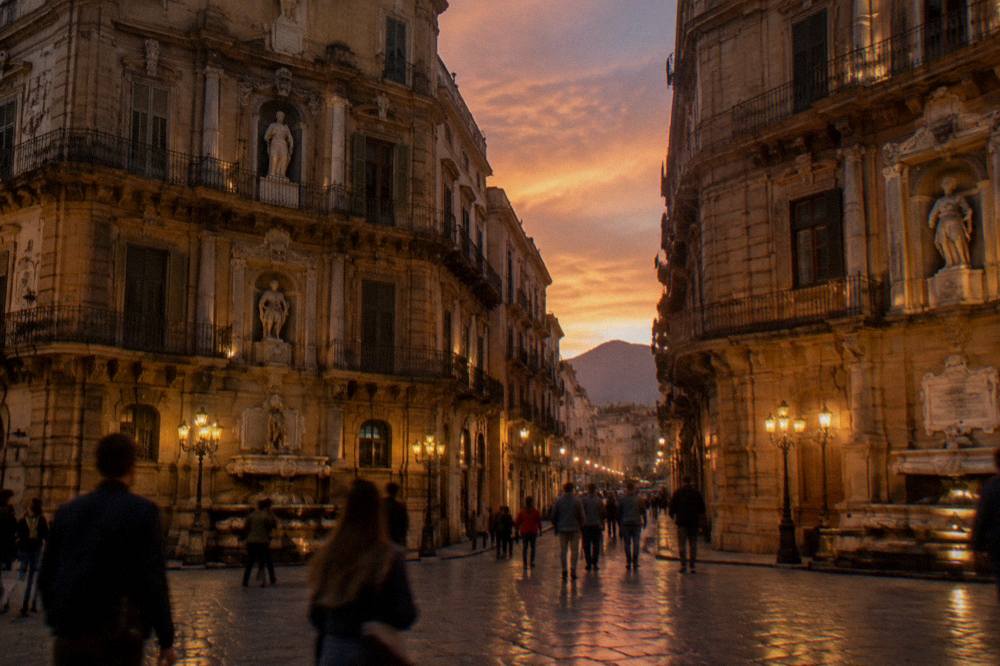
Evening has its own appeal. The streets around the crossing, and the Vucciria and Kalsa quarters nearby, shift into an evening scene of street food and bars, and the municipal tourism pages describe the Vucciria as a market that transforms at night. The crossing itself is at its most photogenic when the facades are lit, which happens reliably in the final hour of daylight.
| Time Of Day | Light And Crowd | Best For |
|---|---|---|
| Early morning | Low sun, quiet streets, deliveries in the markets | Photography, empty corners |
| Midday | Harsh light, busiest traffic and shoppers | Quick pass en route elsewhere |
| Late afternoon | Warm light on eastern facades, passeggiata begins | People watching, golden hour photos |
| Evening | Lit facades, night scene nearby | Food walk, evening stroll |
An evening cooking class is the other way to use the crossing as a starting point: several classes meet in the centre and finish with the meal you prepare. The listing shows times and the current price.
Is The Quattro Canti Free To Visit In Palermo?
Yes, the Quattro Canti is completely free to visit in Palermo, at any hour, because it is a public street crossing rather than a ticketed monument. There is no entrance, no gate and no fee, and the same is true of the surrounding squares and markets, though the individual museums, palaces and churches nearby each set their own entry terms.
The free tier around the crossing is generous. Piazza Pretoria's fountain, the Foro Italico waterfront, Villa Giulia and the markets of Ballarò, Capo and Vucciria all cost nothing to walk through, and many state and regional museums are free on the first Sunday of the month, a point to confirm per site. The paid tier, for visitors who want interiors, is set out below from the figures carried on this site's own pages.
| Site Near The Crossing | Full Ticket | Reduced |
|---|---|---|
| Norman Palace and Palatine Chapel | 14.50 EUR | 12.50 EUR |
| Teatro Massimo guided tour | 14 EUR | 7 EUR under 26 |
| Salinas Archaeological Museum | 7 EUR | 3.50 EUR |
| Galleria d'Arte Moderna | 10 EUR | 8 EUR |
| Capuchin Catacombs | 5 EUR | 3 EUR |
One closure note from the current news: Palazzo Abatellis in the Kalsa is closed or closing for about 18 months of climate-control works from mid-July 2026, with no reopening date, so check the regional museums site before planning that part of a visit.
How Does The Quattro Canti Fit Into A Day In Palermo?
The Quattro Canti works best as the midpoint of a walking day in Palermo: start at the cathedral or the Norman Palace in the west, descend the Cassaro through Piazza Pretoria to the crossing, break for street food in the markets, then continue east to the Foro Italico and the harbour. Every leg of that circuit is a short walk, and no transport is needed between stops.
The site's itinerary pages build exactly this loop. Two days in Palermo gives the crossing a half day with the Cassaro and the Kalsa, while three days in Palermo adds the museums and a beach or day-trip day. For cruise passengers with a single day, the crossing is roughly 15 to 20 minutes on foot from the cruise terminals at the Stazione Marittima and Sammuzzo, per secondary port guides, which makes it the natural first landmark of a shore day.
Getting around needs no ticket if you stay inside the old centre. Buses and trams matter mainly for reaching Mondello or the station, and the AMAT fares page shows 1.40 EUR for a 90-minute ticket, 3.50 EUR for a day and 8.00 EUR for three days. Tap water in Palermo is suitable for drinking according to AMAP, so a refillable bottle covers a walking day without extra cost.
For travellers who want a guide rather than a self-guided loop, the food walks and cooking classes that meet in the centre pair naturally with the crossing as a rendezvous, since every operator in this quarter uses streets within a few blocks of it.
Is The Area Around The Quattro Canti In Palermo Safe?
The area around the Quattro Canti is a normal busy city centre, and the official advisories for Italy, from the US State Department and the UK FCDO, advise standard urban care: petty crime such as pickpocketing and bag-snatching is more common in city centres, at major tourist attractions and on public transport. The crossing itself is a well-frequented junction at most hours.
The practical checks are the ones that work in any Italian city: keep a bag zipped and held in front on a crowded bus, watch belongings in the busy markets, and check the itemised bill in restaurants, where a coperto cover charge is legal when printed on the menu. Tipping is not obligatory anywhere in Italy. The emergency number is 112, with 113 for police and 118 for medical help.
There is no district to avoid here in any official advisory, and the old centre is lively well into the evening around the crossing. The site's page on Palermo safety carries the full advisory wording and the practical checks in one place.
Common Questions About The Quattro Canti In Palermo
What is the Quattro Canti in Palermo?
The Quattro Canti is the crossing of Via Maqueda and Corso Vittorio Emanuele in central Palermo, formed by four curved palace facades with fountains and statues. The municipal tourism page states the crossing divided the old city into the four mandamenti: Capo, Albergheria, Kalsa and Loggia.
Is the Quattro Canti free to visit in Palermo?
Yes. It is a public street crossing with no ticket, gate or opening hours, and it can be seen at any time of day or night.
How long should you spend at the Quattro Canti in Palermo?
Fifteen to thirty minutes is enough to view all four corners and take photographs, though many visitors pass through several times in a day because the crossing sits at the centre of every old-town walk.
What quarters meet at the Quattro Canti in Palermo?
The four historic quarters, called mandamenti, meet at the crossing: Capo or Monte di Pietà, Albergheria or Palazzo Reale, Kalsa or Tribunali, and Loggia or Castellammare, as named on the municipal tourism page.
What is close to the Quattro Canti in Palermo?
Piazza Pretoria is one block west, Palermo Cathedral and the Norman Palace a short walk further, the Teatro Massimo a short walk north along Via Maqueda, and the Ballarò market lies south of the crossing. All are walkable without transport.
When is the best time to photograph the Quattro Canti in Palermo?
Early morning for low sun and quiet streets, or the hour before sunset for warm light on the eastern facades and the evening passeggiata. In summer, the climate table shows July and August means above 26 C, so morning and evening visits are also the comfortable ones.
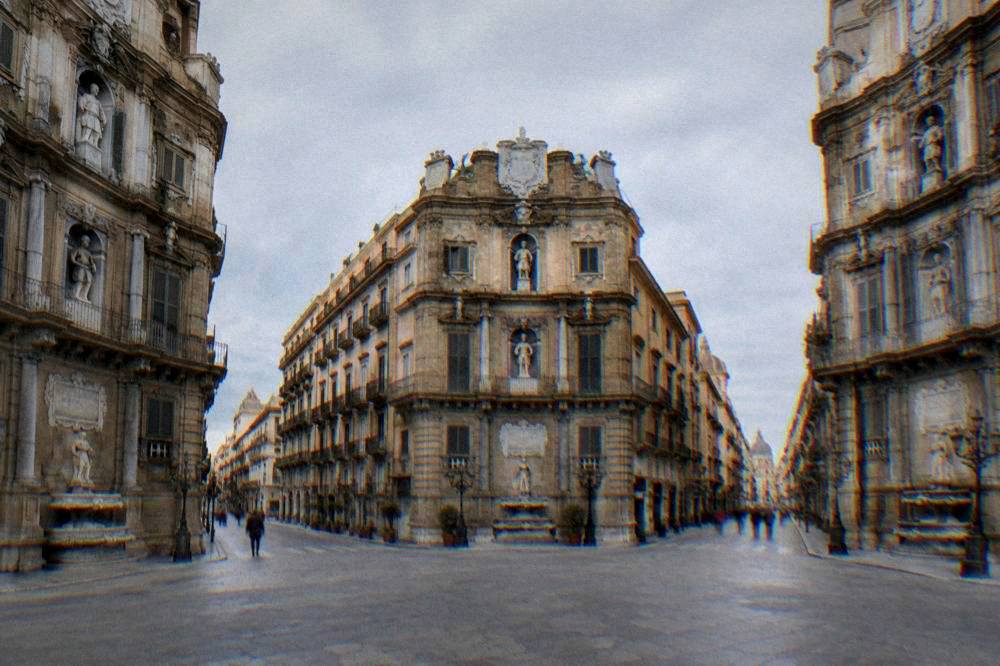
The Quattro Canti earns its place as the anchor of any Palermo visit not because any single corner is elaborate, but because four quarters, two historic streets and the whole logic of the old city meet at one free, always-open junction. Walk it once for the photos, walk it again at dusk, and use it as the compass point from which the cathedral, the palace, the markets and the sea all unfold.