Was Palermo Cathedral A Mosque?
Palermo Cathedral stands on the site of a mosque, and the cathedral's own history page names the conversion dates and the evidence still visible on the porch.
Yes, for a stretch of its long life. Palermo Cathedral, in the heart of Palermo on Sicily's north-west coast, was a mosque for roughly two and a half centuries, and the building itself still carries the proof. The cathedral's own history page states that in 831 Saracens conquered the city and transformed the earlier church on the site into a large mosque called the Gami, and that in 1072 the Normans conquered Palermo and returned the ancient cathedral to Christian worship. A Qur'an verse carved on the first column on the left of the southern porch survives from the mosque phase, visible to anyone walking the porch today.
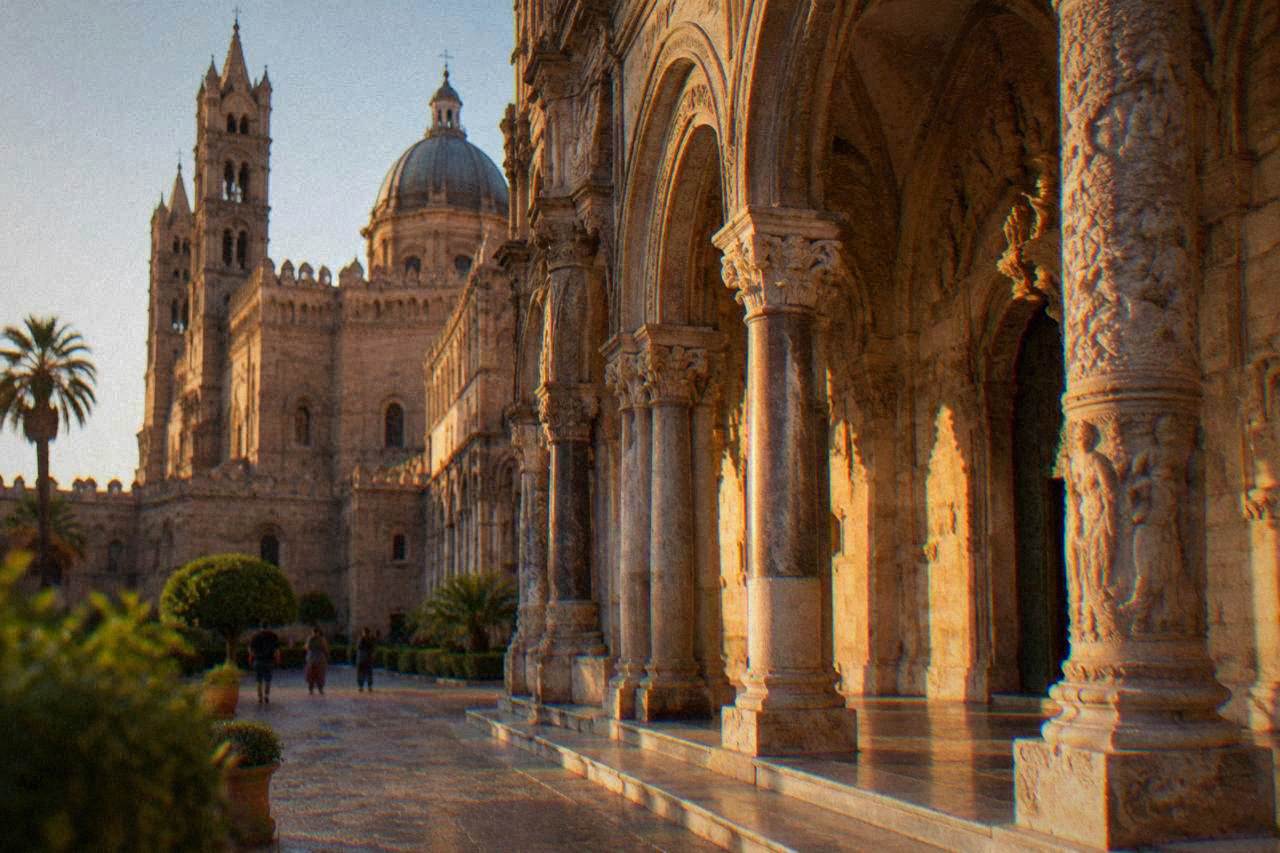
The site's story is a layered one, and the mosque period is only one layer of a building that has been reshaped repeatedly since. For the practical side of a visit, the Palermo Cathedral attraction guide covers the monumental area and its ticketing, and the wider old town context is covered in the old town centre guide.
The question is a common one, and it deserves a precise answer rather than a vague yes. The building was not founded as a mosque, and it did not remain one. It passed through a Christian phase, a Muslim phase, and then a long Christian sequence again, and each phase left marks that the next phase worked around. Understanding that sequence changes how the cathedral looks on a visit, because the porch, the walls and the tombs stop reading as a single design and start reading as a record.
Was Palermo Cathedral A Mosque?
Yes, the building that stands on the cathedral site in Palermo functioned as a mosque from 831 until 1072. The cathedral's own history page records that Saracens modified the earlier church into a large mosque called the Gami, and that the Normans then returned it to Christian worship under Bishop Nicodemo. The earlier church already stood on the spot before that conversion, so the site was Christian, then Muslim, then Christian again.
The dates matter because they anchor everything else. The year 831 is when Saracen Palermo absorbed the existing church into a mosque, and 1072 is when the Norman conquest restored Christian worship. Both dates come from the cathedral's own chronicle page, which is the closest thing to an official account of the building's early phases. The same page names the mosque as the Gami, a word worth remembering because it appears in older descriptions of the city.
Two layers sit under the question. First, the site itself carried a church before 831, which means the mosque was a conversion rather than a fresh foundation. Second, the building visible today is not that mosque and not that first church: it is a structure reworked many times across the centuries, keeping traces of each phase rather than preserving any single one intact. That distinction is the honest answer to the question, and it is also what makes the building interesting.
The word "mosque" also needs care. The Gami was a large congregational mosque, the principal Muslim place of worship of a city that was, under Saracen rule, one of the great cities of the Mediterranean. The cathedral's history page does not describe the interior arrangements of that mosque, so nothing specific can be said here about prayer halls, mihrabs or courtyards. What the page does state is the conversion, the name, the dates and the surviving carved evidence.
Where Can You Still See The Mosque Phase In Palermo?
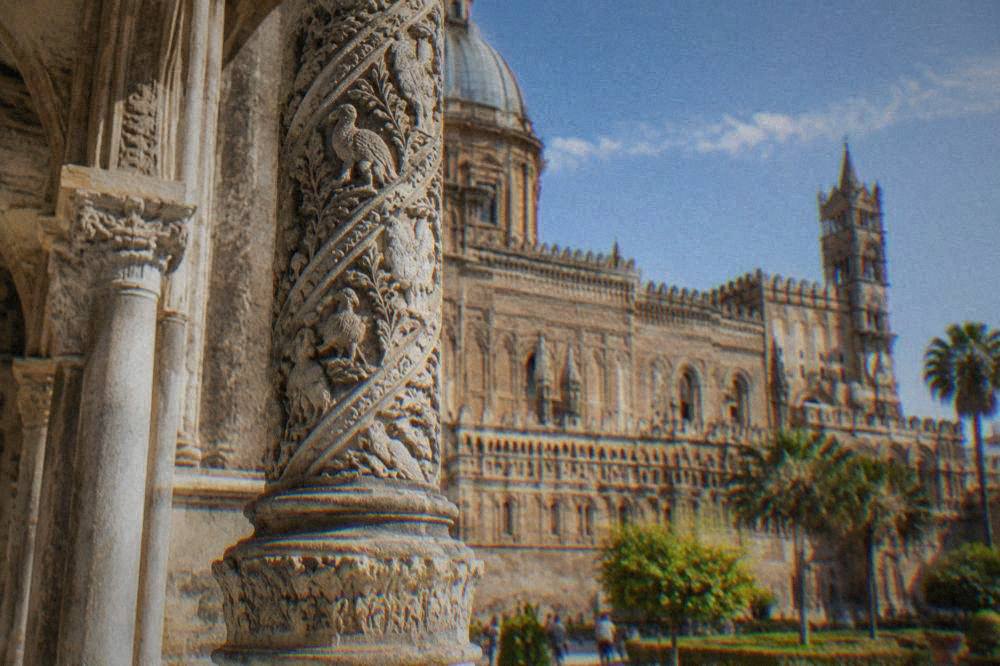
The clearest surviving trace is the Qur'an verse on the first column on the left of the southern porch, which the cathedral's history page names as testimony to the mosque period. Beyond that column, the evidence is structural rather than displayable: the site itself, reused and reworked, carries the Muslim phase in its foundations and orientation rather than in a museum vitrine.
The porch column is the detail to seek out. It is not signposted as a separate attraction and it forms part of the ordinary architecture of the walk around the cathedral's exterior, so a visitor who knows to look left at the southern porch will find it, and a visitor who does not may walk past. The cathedral's own page singles it out, which is as close to an official pointer as exists.
The rest of the mosque phase survives as absence and overlap. Nothing in the current interior is presented as a prayer hall of the mosque period, and the building's later reworkings sit on top of the earlier layers. That is typical of Palermo's historic centre, where the UNESCO listing itself frames the city's heritage as a set of interlocking traditions rather than single-period monuments.
| Phase | Date | What the cathedral's history page says |
|---|---|---|
| Earlier church on the site | Before 831 | A church already stood on the spot |
| Mosque (the Gami) | 831 | Saracens modified the earlier church into a large mosque |
| Return to Christian worship | 1072 | Normans returned the ancient cathedral to worship under Bishop Nicodemo |
| UNESCO inscription | 2015 | Arab-Norman Palermo and the Cathedral Churches of Cefalu and Monreale |
If the layered-history angle appeals, the city has more of it within a short walk, and a guided visit turns the layers into a narrative rather than a list. The same historic centre holds the Teatro Massimo, whose guided tour covers the opera house in depth, and the Teatro Massimo guided tour pairs well with a cathedral morning. Check availability
To walk the layers with a local guide, book a free welcome tour here.
What Stood On The Site Before The Mosque?
The cathedral's history page places an earlier cathedral on the site, built between 590 and 602 under Bishop Vittore and dedicated to the Virgin Mary, with Pope Gregory the Great authorising the dedication in 604. That earlier church is the building the Saracens modified in 831, which means the site has carried a major church for the overwhelming majority of its recorded life.
This pre-mosque layer is the part of the story that usually surprises readers. The question "was it a mosque" often assumes a simple before and after, but the cathedral's own chronicle describes a sequence that begins with a substantial late antique church, continues through the mosque conversion, and then resumes Christian use. The dates 590 to 602 come from the same official page as the 831 and 1072 dates, so the whole arc rests on one consistent account.
Scholarly work referenced alongside the official page describes the earlier structure as a Christian basilica of the period, and the cathedral page notes that the Saracens "modified" the existing building rather than demolishing it. Modification rather than replacement is the recurring pattern of the site, and it is why so many phases remain legible in one place. A building that had been flattened and rebuilt fresh would tell a much thinner story.
For the visitor, none of this early phase is on display as a separate space. It exists as the lowest of the site's layers, known from the written record and from study of the structure, and the visible cathedral belongs to its later lives. That gap between what is documented and what is visible is worth setting expectations around: the mosque phase has one named carved trace, and the pre-mosque church has none on public display.
Who Is Buried In Palermo Cathedral?
The Chapel of the Royal Tombs holds the sarcophagi of Roger II, the first king of Sicily, Constance of Hauteville, Henry VI of Swabia, Frederick II and Constance of Aragon, the first wife of Frederick II. Surveys of the tombs also record the presence of Pietro d'Aragona and one unidentified woman. These burials belong to the royal court that ruled Sicily after the Norman conquest.
The tombs are the cathedral's strongest pull after the architecture itself, and they connect directly to the 1072 story: the dynasty that returned the building to Christian worship later buried its kings and emperors inside it. Roger II, who died in 1154, is the name visitors come for, but Frederick II, who died in 1250, carries equal weight in the longer arc of Sicilian rule. The presence of two emperors of the Holy Roman Empire in one chapel in Palermo is the clearest sign of how central this city was to medieval Mediterranean power. The wider set of guides lives on Palermo Italy Travel Guide.
| Tomb | Occupant |
|---|---|
| Porphyry sarcophagus | Roger II, first king of Sicily |
| Imperial sarcophagus | Henry VI of Swabia |
| Imperial sarcophagus | Frederick II |
| Royal burial | Constance of Hauteville |
| Royal burial | Constance of Aragon, first wife of Frederick II |
For the full burial story, including the practical questions around the royal tombs as a ticketed part of the monumental area, see who is buried in Palermo Cathedral. The monumental area's ticketing is covered separately in do I need tickets for Palermo Cathedral, and the roof itinerary questions in rooftop ticket costs.
How Does The Mosque Story Fit The UNESCO Listing For Palermo?
Palermo Cathedral is one of nine components of the UNESCO World Heritage property inscribed in 2015 under the name Arab-Norman Palermo and the Cathedral Churches of Cefalu and Monreale. The listing covers the Royal Palace and Palatine Chapel, the Zisa, Palermo Cathedral, Monreale Cathedral, Cefalu Cathedral, San Giovanni degli Eremiti, La Martorana, San Cataldo and the Admiral's Bridge.
The listing's own name encodes the cathedral's story. A property called Arab-Norman Palermo exists precisely because the city's great buildings grew from Arab and Norman traditions sitting side by side, and the cathedral's passage from church to mosque and back is the clearest single example of that layering. UNESCO's decision to inscribe nine components rather than one building reflects the same idea: the heritage is a network, not a monument.
| UNESCO component (2015) | Location |
|---|---|
| Royal Palace and Palatine Chapel | Palermo, central |
| Palermo Cathedral | Palermo, central |
| Zisa | Palermo |
| San Giovanni degli Eremiti | Palermo |
| Santa Maria dell'Ammiraglio (La Martorana) | Palermo |
| San Cataldo | Palermo |
| Admiral's Bridge | Palermo |
| Monreale Cathedral | Monreale, above Palermo |
| Cefalu Cathedral | Cefalu, on the coast east of Palermo |
Several of these components sit within walking distance of the cathedral, which makes the listing unusually walkable. San Cataldo and La Martorana face each other across the same small square in the old centre, and the old town layout, described in the municipal tourism pages as four districts meeting at the Quattro Canti, puts the whole set of central components inside a compact area. The mosque-to-cathedral story is therefore not an isolated curiosity but the interpretive key to a whole day of sightseeing.
The two cathedrals named alongside Palermo in the listing reward the comparison. Monreale Cathedral, a short trip from the city, holds the tombs of William I and William II, and the question who is buried in Monreale Cathedral is a natural follow-on. A half-day trip covering both Monreale and Cefalu is one of the easiest ways to see the other two cathedrals of the UNESCO name in a single outing, and the Monreale day trip guide covers the route.
Visitors with more time in Sicily often extend the same layering theme to the island's Greek sites, and a day trip to Agrigento's Valley of the Temples, itself a UNESCO property since 1997, pushes the historical reach of one itinerary back even further.
What Should You Know Before Visiting Palermo Cathedral?
The cathedral is a working church at the centre of Palermo, and its monumental area, covering the roof, the royal tombs and the treasury, is ticketed, with prices shown at the ticket point and on the cathedral's own ticket shop rather than on the main hours page. The official page lists season-dependent hours and notes that visits are suspended during liturgies, so the day and time of a visit shape what is open.
Dress matters in a working church. Covered shoulders and knees are the standard expectation, and this can be stated plainly even where a fixed dress code is not published as a rule of law. The roof itinerary carries its own cautions on the official page, which advises against it for visitors with heart, claustrophobia or vertigo issues and asks for comfortable shoes. Those advisories come from the cathedral's own visitor information.
The surrounding streets shape the visit too. The cathedral sits on Via Vittorio Emanuele, the historic Cassaro, the long axis of the old city that runs from the Norman complex at one end toward the sea at the other. The street food and market culture of the old centre, described across this site's market pages, means a cathedral visit slots easily into a morning that also takes in Ballarò or the Capo. Nothing about the visit needs to be a standalone expedition.
Practical planning questions around the city as a whole, from arrival at the airport to how many days to allow, are covered in dedicated pages elsewhere on this site. The cathedral itself is free to walk around outside at any hour, and the exterior alone, with the porch and its carved evidence, delivers the core of the mosque story.
Common Questions About Palermo Cathedral
Was Palermo Cathedral a mosque?
Yes, from 831 until 1072. The cathedral's own history page records that Saracens modified the earlier church into a large mosque called the Gami, and that the Normans returned it to Christian worship in 1072. A Qur'an verse carved on a porch column survives from the mosque phase.
Can you still see evidence of the mosque in Palermo Cathedral?
The named trace is the Qur'an verse on the first column on the left of the southern porch. The rest of the mosque phase survives in the site's layers rather than as a displayed space.
Was there a church before the mosque?
Yes. The cathedral's history page says the Saracens modified an earlier cathedral built between 590 and 602 under Bishop Vittore and dedicated to the Virgin Mary, so a church already stood on the site before the 831 conversion.
Who returned the cathedral to Christian worship?
The Normans, in 1072, handing the building to Bishop Nicodemo, according to the cathedral's own chronicle.
Is Palermo Cathedral part of a UNESCO site?
Yes. It is one of nine components of Arab-Norman Palermo and the Cathedral Churches of Cefalu and Monreale, inscribed in 2015.
Do you need tickets for the mosque-era parts of the cathedral?
The porch with its carved column is on the exterior walk, and the monumental area covering the roof, royal tombs and treasury is ticketed, with prices shown at the ticket point or on the cathedral's ticket shop.
The mosque period is a single chapter of a building that has served two faiths and carried royal tombs, and it explains why the UNESCO listing names Palermo alongside Cefalu and Monreale. For everything the visitor sees on the ground, the porch column is where that chapter remains visible.
